


Iceland is easy to reach but surprisingly complex to move around in. Distances look short on the map, the Ring Road seems straightforward, and rental cars are widely advertised. Yet weather, seasonal darkness, gravel roads and limited public transport can turn a casual plan into a serious safety issue. Choosing the right way to get around is as important as choosing the right itinerary.
Arriving in Iceland: Keflavík vs Reykjavík Airports
Most visitors arrive at Keflavík International Airport, commonly shortened to KEF. It sits on the Reykjanes Peninsula, roughly 50 kilometers from central Reykjavík, with no passenger train connection and no metro. This is not the same as Reykjavík Airport, coded RKV, which is a smaller domestic airport located just south of Reykjavík’s city center. Understanding the difference between the two is essential for planning transfers and domestic connections.
Keflavík International Airport handles almost all international flights. When you land from North America or mainland Europe, this is where you clear passport control and customs. Reykjavík Airport, by contrast, is where many domestic flights depart for towns such as Akureyri, Egilsstaðir and Ísafjörður. A transfer between KEF and RKV is therefore an extra leg in your journey, which can take around 45 minutes to an hour by road under normal conditions, plus time to collect luggage and check in again.
Travelers sometimes assume a short gap between an international arrival and a domestic departure will be fine because the airports share the Reykjavík name. In reality they are separate facilities with different runways, terminals and ground transport options. If you plan to fly within Iceland on the same day you arrive, it is wise to allow generous buffer time between KEF and RKV, especially in winter when road and weather conditions can slow traffic.
Reykjavík Airport itself is convenient to the city center and reachable on foot from some hotels, or via a short taxi or city bus ride. However, there is no regular direct bus from Keflavík to Reykjavík Airport. You will typically travel from KEF to Reykjavík’s BSÍ Bus Terminal or another city stop first, then continue by taxi or local bus to the domestic airport.
Airport Transfers: Flybus, Route 55, Shuttles, Taxis and Rental Cars
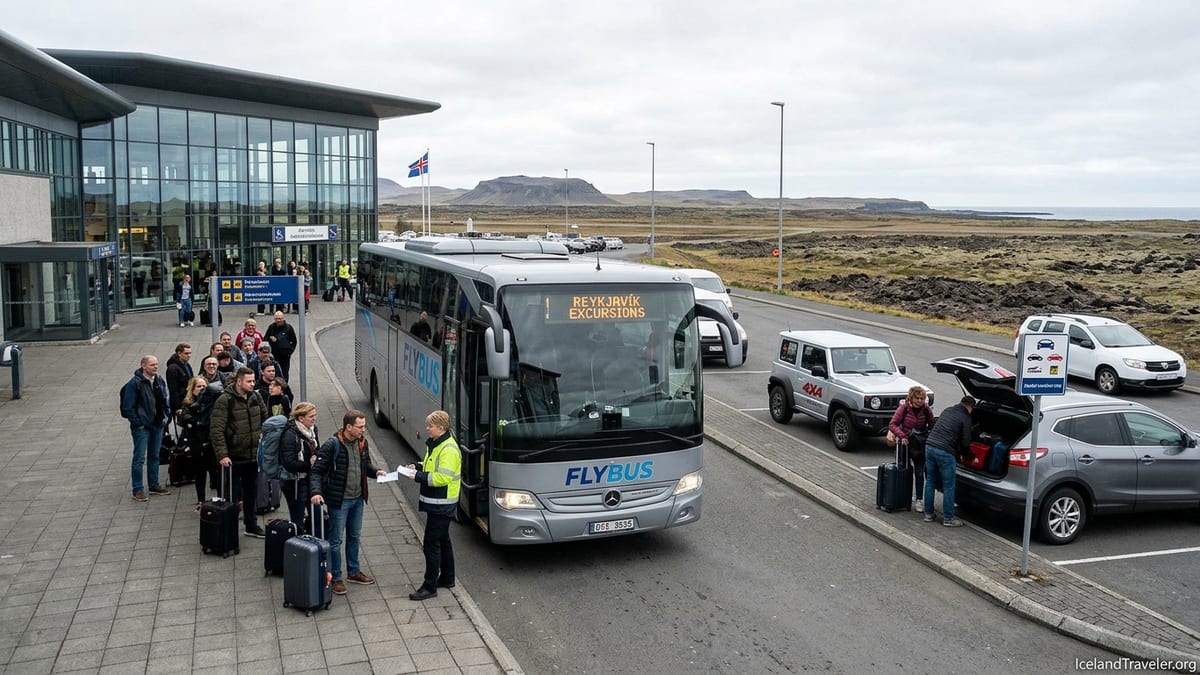
Keflavík Airport’s official transport information highlights Flybus as a regular airport transfer service operating in connection with arriving international flights. Buses depart roughly 35 to 45 minutes after each arrival, with additional departures in peak periods, so you do not need to match a specific timetable in advance. Tickets can usually be purchased online before travel or on arrival from desks and self-service kiosks in the terminal.
Flybus typically runs between KEF and Reykjavík’s BSÍ Bus Terminal, a central transport hub just south of downtown. Some tickets include only the main transfer to BSÍ, while others include an additional drop-off or pick-up at selected hotels or designated bus stops in the city. The distinction matters: a BSÍ-only ticket means you must arrange onward travel from the terminal, while a hotel or bus-stop ticket includes a shorter connecting ride operated by a city shuttle that meets the main coaches.
Strætó’s Route 55 is the scheduled public bus linking Keflavík Airport with Reykjavík on a fixed timetable. It is part of the broader Icelandic bus network rather than an airport-only shuttle. The schedule is less frequent than Flybus and may not align closely with late-night or early-morning flights. It can be an economical option for flexible travelers, but you should not expect it to wait for delayed planes or to serve hotel front doors. Route 55 generally stops at the airport, several towns on the peninsula, and key points in the capital area, including BSÍ according to the 2026 timetable.
Licensed taxis and private shuttles provide door-to-door transfers at a higher cost but with maximum convenience, especially for families with young children, bulky luggage or mobility needs. Official guidance recommends confirming fares or metered pricing directly with operators or through your hotel, as prices can fluctuate with distance, time of day and fuel costs. Rental cars are another common solution: desks are located at or near KEF, with some companies using short shuttle rides to off-airport lots. Collecting a car on arrival gives you full flexibility from the first day, but only if you are ready to drive after a long flight and prepared for local conditions.
Do You Need a Rental Car in Iceland?
A rental car is often the most flexible way to explore Iceland, particularly for Ring Road itineraries, remote regions and photographers chasing light at odd hours. On a seven to fourteen-day summer trip focused on the south coast, Snæfellsnes Peninsula or parts of the north, a car lets you stop at viewpoints, visit lesser-known hot springs and adjust plans if a particular site is crowded or socked in with low cloud. Many travelers find that the freedom to pull off at signed viewpoints or detour to a small fishing village is worth the cost.
However, a car is not always necessary or appropriate. If your stay is just a few days focused on Reykjavík and a couple of well-known day trips such as the Golden Circle or South Coast, guided coach tours and day excursions can be more efficient. Parking in central Reykjavík is paid in many zones, and winter visitors can face icy streets and strong winds even before leaving the city. For very short stays, you may spend more time and stress managing a vehicle than you gain in independence.
Winter and shoulder seasons introduce further complications. Snow, black ice, hurricane-force wind gusts in open areas and quickly changing visibility can all turn a straightforward itinerary into a hazardous challenge. In many cases, especially from November through March, it is safer for most visitors to rely on experienced local drivers via tours or scheduled buses rather than learning Icelandic winter driving skills on the fly. If your main goal is to see northern lights, remember that they are visible from many places outside Reykjavík on clear nights reached by tours, without needing to handle a rental car at night in sub-zero temperatures.
Travel costs also influence the decision. Rental prices, fuel, insurance upgrades, parking fees and potential gravel damage can make a self-drive trip significantly more expensive than using buses and tours, especially for solo travelers or couples. By contrast, a family or small group can split the cost of a car and make it comparatively better value, particularly on longer stays where regional bus options are limited.
Driving in Iceland: Roads, Rules, Hazards and Insurance
Iceland’s roads fall into several broad categories that matter for safety and vehicle choice. The best-known is Route 1, the Ring Road. Large stretches are paved and relatively wide, suitable for normal two-wheel-drive cars in good weather. However, some sections are still narrow, include single-lane bridges and can become slippery or snowy outside summer. Secondary paved roads connect towns and popular sights such as the Golden Circle attractions. These may be narrower than you expect, sometimes without shoulders.
Then there are gravel roads, which range from fairly smooth surfaces to rough, potholed tracks with loose stones, washboard corrugations and blind crests. Gravel can chip paint, crack windshields and reduce traction, especially if you drive too fast. Finally, designated highland F-roads lead into the interior. Icelandic emergency and road authorities emphasize that F-roads require appropriate vehicles and experience. They are generally only open in summer, feature river crossings and rough terrain, and are absolutely not suitable for standard two-wheel-drive rental cars.
It is also illegal to drive off marked roads and tracks, including across fragile volcanic moss, sand plains and other open terrain. Tire marks can last for decades in such landscapes. A genuine four-wheel-drive vehicle with higher clearance is often required for many F-roads, but having 4WD does not make flooded rivers safe to cross or override road closures. There is an important difference between a vehicle that mechanically has four-wheel drive, a standard two-wheel-drive rental intended only for paved and some gravel roads, and a rental contract that explicitly allows limited travel on specified F-roads. Always check your rental agreement carefully and assume that ignoring restrictions can void insurance coverage and lead to substantial repair bills.
Before any drive, it is essential to check Iceland’s official road-condition map, national weather forecasts and safety advice. These sources report closures, wind warnings, icy surfaces, snowfall, visibility issues and flood risks. Conditions can vary dramatically within a short distance; a clear section near Reykjavík can give way to strong crosswinds or black ice on an exposed plateau. Speed limits typically range from about 50 km/h in urban areas to around 90 km/h on rural paved roads, with lower limits on many gravel sections. Stopping in the travel lane or at blind hills to take photos is both dangerous and prohibited; always use designated lay-bys or safe pullouts.
Additional hazards include single-lane bridges, where approaching drivers must slow and yield, often to the vehicle that arrives first. Free-roaming sheep and, in some regions, horses can wander onto the road, particularly in summer, and collisions can be serious for both animals and people. Strong winds can damage car doors if you open them fully on gusty days, so hold doors firmly and park facing into the wind if possible. In winter, black ice and compacted snow require gentle steering, longer braking distances and slower speeds than many visitors are used to.
Insurance choices are another critical aspect of Iceland car rental. Basic collision damage protection, often included, typically comes with a high excess, meaning you are liable for a large amount of any repair bill. Many companies offer extra gravel protection for windshield and bodywork chips, as well as separate sand-and-ash coverage for storms that can sandblast paintwork in parts of the south. Options to lower the excess are common, but coverage varies by company. The only way to know what is included, excluded and capped is to read the actual contract and terms, including details on damage from river crossings, underbody impacts, wind-damaged doors and driving on prohibited roads.
Getting Around Without a Car: Buses and Klapp
Iceland has no passenger trains, so buses form the backbone of public transport. Strætó operates city buses in the Reykjavík area and a network of regional routes, supplemented by private operators on specific corridors and seasonal routes. Within the capital region in 2026, Strætó’s published information lists a single adult fare of 690 Icelandic krónur for local journeys. Children 11 and under ride free under current rules, making buses an economical choice for families staying in the city.
The Klapp payment system is used on Strætó services in and around Reykjavík. Travelers can pay by loading credit onto a physical Klapp card, using a smartphone app or buying time-based passes, depending on their needs. Single tickets allow travel for a set period, typically sufficient to transfer between lines without buying a new fare. It is worth familiarizing yourself with how to validate your ticket or scan your card when boarding, as drivers do not handle cash on many routes.
Regional bus journeys use different fare structures, usually based on distance zones or specific route pricing. Some longer routes run daily year-round, while others operate seasonally or on certain days of the week. For sparsely populated areas, it is common for routes to require advance reservations or to operate only when there is a confirmed booking. This is quite different from simply walking onto a frequent city bus; visitors should check timetables carefully and plan connections with enough margin to handle weather-related delays.
Buses can reach a wide variety of sightseeing hubs such as Akureyri, Selfoss, Hvolsvöllur, Vík, Höfn and Ísafjörður, from which tours or local taxis can reach nearby attractions. However, a regional bus stopping in a town does not mean it will stop at an isolated waterfall, canyon or glacier parking lot nearby. For example, you might reach a coastal village by bus but still need a separate local transfer or guided tour to visit a nearby glacier tongue or sea-cliff viewpoint. Always verify where the bus stop is relative to the sights you intend to visit, especially in winter when walking along narrow roads can be dangerous.
Domestic Flights: When Flying Saves Time
Domestic flights make Iceland’s long distances more manageable, especially if you have limited time and want to include distant regions in a single trip. From Reykjavík Airport, scheduled services typically connect to Akureyri in the north, Egilsstaðir in the east and Ísafjörður in the Westfjords, among other destinations served seasonally or by smaller aircraft. Flight times between Reykjavík and these towns are usually under an hour, compared with many hours of driving on two-lane roads.
Flying can be a major time-saver for itineraries such as Reykjavík to Akureyri for a few days exploring the north, or Reykjavík to Egilsstaðir to focus on Eastfjords hiking and coastal drives. It can also be useful in winter when road conditions in the interior or over mountain passes are unreliable. However, domestic flights are subject to weather and visibility limitations, especially in fjord regions where wind, low cloud and storms can lead to delays or cancellations. Plan with flexibility rather than scheduling tight same-day connections with onward international flights.
The need to travel between Keflavík and Reykjavík airports can also erode some of the time advantage. If you land at KEF, then take a bus or taxi into Reykjavík, then check in at RKV for a domestic flight, the combined journey can approach the duration of driving partway along Route 1, particularly in shoulder seasons. In such cases, a one-way domestic flight back toward Reykjavík at the end of the trip, or a single flight to reach a far-flung base like Ísafjörður, may offer better value than multiple back-and-forth hops.
Luggage allowances on domestic flights may be more restrictive than intercontinental limits, especially for camera equipment, skis or hiking gear. Check baggage rules in advance and factor potential excess fees into your budget. For some travelers, a combination of one strategic domestic flight plus regional buses or car rental at the destination offers the most efficient compromise.
Ferries and Sea Routes: Islands and Fjords
Ferries add another dimension to getting around Iceland, particularly for islands and remote peninsulas. The best-known service for visitors is the car and passenger ferry between Landeyjahöfn on the south coast and Vestmannaeyjar, the Westman Islands. This route is operated by Herjólfur, carrying both foot passengers and vehicles. Sailings are scheduled multiple times per day in most seasons, but are highly dependent on sea conditions, harbor access and weather. In rough seas or when conditions at the shallow Landeyjahöfn harbor are unfavorable, sailings may be rerouted or canceled.
The Westfjords region is also served by several ferry routes that shorten driving times or provide access to sparsely populated areas. One important connection links the southern and northern Westfjords, allowing passengers and cars to cross instead of driving around long fjords by road. Services to smaller islands, such as those in northern Iceland, often operate seasonally, with reduced or no service in the darkest winter months. Vehicle capacity on these ferries can be limited, so advance booking is strongly recommended if you are traveling with a car during the busy summer holiday period.
There are also passenger-only boat excursions to islands, bird cliffs and remote nature reserves that function more like tours than public-transport ferries. These might operate from harbors such as Húsavík, Ísafjörður or Stykkishólmur, focusing on whale watching, puffin colonies or wilderness hiking. While they are part of the broader transport picture, you cannot rely on them as daily commuting links; departures are typically tailored to tourist demand and only run in specific seasons.
For travelers arriving from mainland Europe without flying, a seasonal long-distance passenger and vehicle ferry connects Seyðisfjörður in East Iceland with ports such as Hirtshals in Denmark via the Faroe Islands. This route brings travelers directly into eastern Iceland, bypassing Reykjavík entirely. Sea conditions on the North Atlantic can be severe at times, leading to schedule changes, so anyone planning to use this route should allow for flexibility at both ends of the journey.
Planning Iceland Transportation: Trip Length, Season and Style
Choosing between a rental car, guided coach, regional bus, domestic flight or campervan depends on how long you have, when you travel and how much flexibility you need. For a seven-day summer trip, a compact rental car with appropriate insurance is often the most versatile option, allowing a loop of Reykjavík, the south coast and perhaps Snæfellsnes. Fuel, rental costs and insurance add up, but for two to four people the per-person price can compare favorably with multiple guided tours. A campervan can combine transport and accommodation, but it is bulkier, more exposed to winds and subject to strict rules about legal overnight parking.
For a seven-day winter trip focused on Reykjavík and a couple of excursions, guided coaches and day tours shine. Airport transfers by Flybus or similar services, combined with walking, city buses and organized tours to the Golden Circle, South Coast or northern lights, avoid the risk of driving in storms. You still need to plan ahead for tour availability during peak holiday periods, but you are not responsible for navigation, tire choice or deciding whether the road over a particular pass is safe that morning.
On a fourteen-day summer journey, combining modes can be very effective. One option is to take a domestic flight from Reykjavík to Akureyri or Egilsstaðir, rent a car locally for several days in that region, and then return by bus or flight. This reduces one-way driving time and spreads risk if a storm affects only part of the country. For budget-conscious travelers, regional buses can connect major towns, with short local tours filling gaps to specific waterfalls, lagoons or glaciers.
In winter, longer itineraries demand even more flexibility. Storms can close roads with little warning and high winds can make it unsafe to drive tall vehicles like campervans. A mix of domestic flights, regional buses and selectively rented cars on the safest stretches gives you more options to adjust plans when forecasts deteriorate. Whichever mode you choose, book key tickets and rentals in advance for peak periods, but keep at least one backup plan for each major leg of your journey so that Iceland’s dramatic weather adds awe to your trip rather than avoidable stress.